
|
By Matt Wilson, Entomologist at Stroud Water Research Center We were curious to find out what are the dominant stream taxa across the Great Plains, Eastern Temperate Forest, and Northern Forest ecoregions? For most field ecologists – myself included – we tend to focus on a few research questions and/or geographic areas. As a result, it can be natural to incorporate what we see in our research and in our samples into our mental model of which taxa are more broadly common in streams. In other words, if we focus our research on the changes resulting in headwater streams from agriculture then most of what we see reflects the animals present in small streams and the tolerant taxa found in agriculture. Or if we focus on conservation of a specific watershed then our mental model has a tendency to narrow in geography. To compensate for this, and remove any personal bias from taxa selections, I took advantage of a dataset that is both professionally curated and publicly available from the National Water Quality Monitoring Council (NWQMC; http://waterqualitydata.us/). This dataset included decades of samples from the US Geological Survey, Environmental Protection Agency, and NWQMC collected across the United States and a few select sites in Canada. 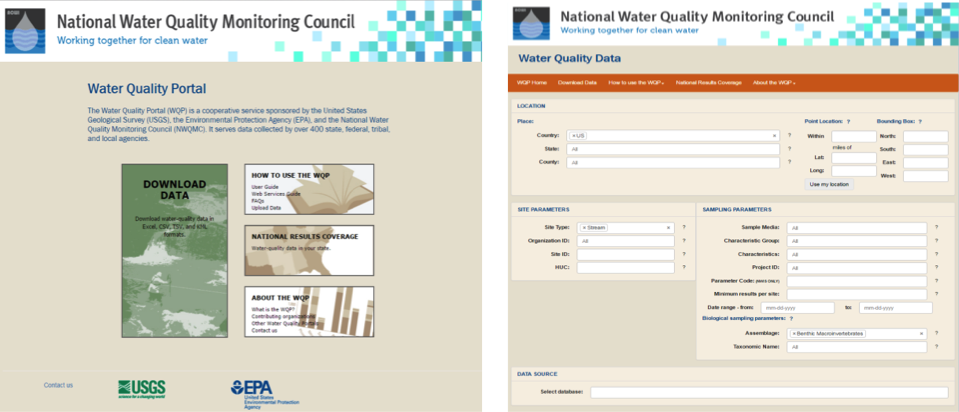 NMQMC Portal. I primarily chose this particular dataset because:
My goal was to identify the most frequently collected taxa across ecoregions East of the Rocky Mountains and use these results to help us decide which taxa citizen scientists might be more or less likely to encounter in their samples. We then incorporated taxa we had not previously considered if they were frequently collected. In order to create this list, I selected all the states completely (or nearly completely) within an Ecoregion 5, 8, 9; <ftp://ftp.epa.gov/wed/ecoregions/cec_na/NA_LEVEL_I.pdf> as LOCATION and then chose 'Benthic Macroinvertebrates' and 'Invertebrates' as the Assemblage(s) under SAMPLING PARAMETERS. I then imported the file exported by http://waterqualitydata.us/ into RStudio (open source statistical software). After using a few logical statements to make sure only aquatic benthic invertebrate samples were included (the database includes marine samples too) I summed all the sample records by their unique taxa and ranked them by abundance. While the samples in this database might not be completely random, it is fair to say the 17.5 million invertebrates included in these samples are more likely to represent the eastern US than our individual research collections 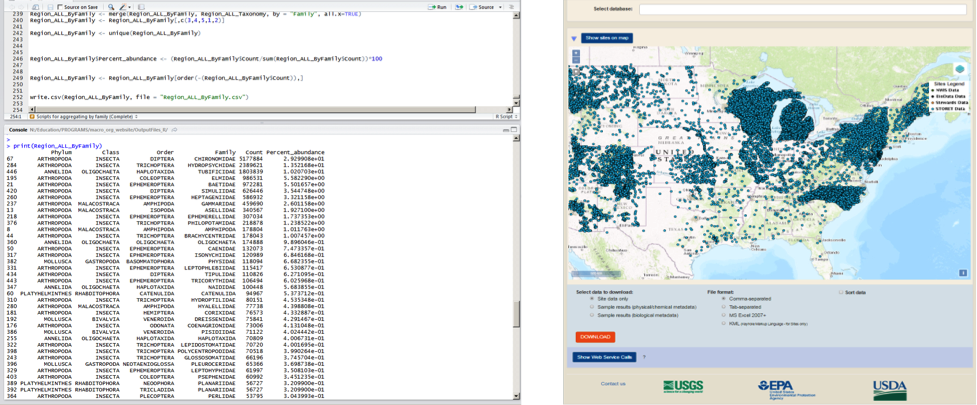 Output and results from the R analysis across all regions (left) and data point locations across all ecoregions (right). Comments are closed.
|
Project TeamAn interdisciplinary team Categories
All
Archives
June 2023
|
 RSS Feed
