
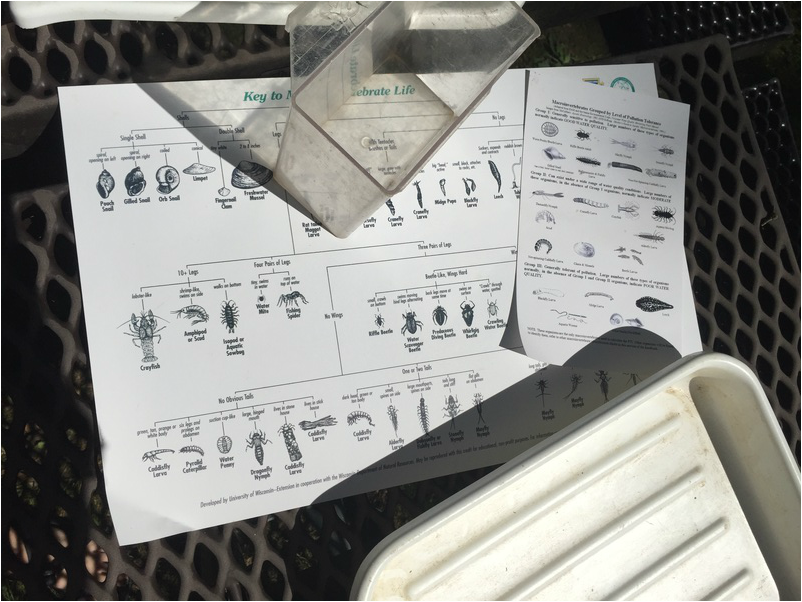
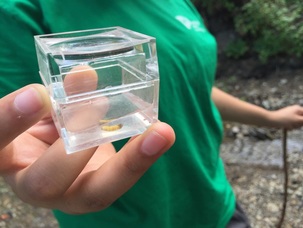
When I spend time with volunteers and learners, I try to spend the first part of my time with them listening to the things that they talk about and the ideas and questions that they have. This group of young people were very inquisitive about the world around them--something that probably led to their participating in this program. They asked lots of questions about trees, birds, insects, and the ecology of the parks and streams that we visited over the past few weeks. One thing that we didn't spend a lot of time talking about was taxonomic classification--the major focus of the Learning to See, Seeing to Learn project. I found this to be interesting, but not really surprising--the focus of this program is not on taxonomic classification or identification, but on the broader aspects of urban ecology and how to gauge what is happening in urban environments with regard to natural and human-influenced landscapes. The students used two different simple, one-page guides to identify the macroinvertebrates that they found (they collected with nets and by "hand picking" macroinvertebrates out from underneath rocks and logs). These guides got them to order-level identification, and sometimes differentiated large groups within orders (such as 'netspinning caddisflies' and 'casebuilding caddisflies'). But the guides they used didn't take identification all the way to family-level, nor did they use latin names for the orders.
This observation is not to say that they need to be using latin names, but an observation that sometimes it is easier for novice taxonomists to identify organisms that have names that are descriptive or familiar sounding. Common names for insects and other macroinvertebrates can be easier for folks to remember than latin names (but latin names sometimes have their utility and descriptiveness, too). In thinking about future training materials and supports, I wondered if these volunteers would be engaged more in taxonomic classification if they had different tools or training materials to scaffold such thinking and learning. If there were motivation to use a more detailed IBI that required more detailed identification (to family level, or at least counting different families, if not naming them explicitly), perhaps volunteers would find ways to engage with and build their "chops" for more rigorous identification. Comments are closed.
|
Project TeamAn interdisciplinary team Categories
All
Archives
June 2023
|
 RSS Feed
