
|
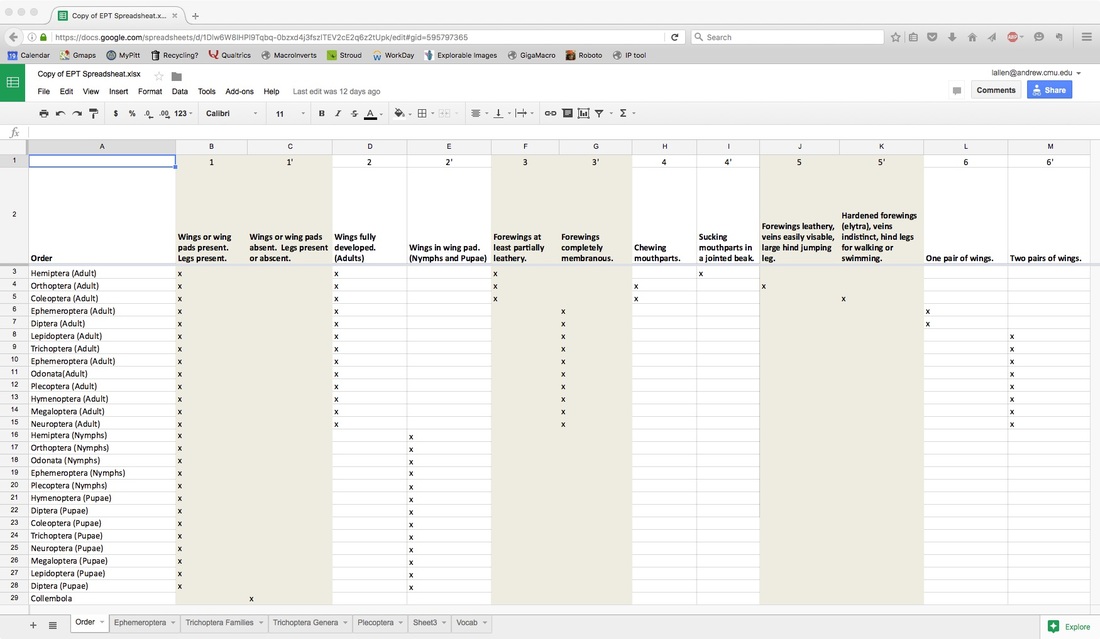
By Lauren Allen Part of designing a new content management system (CMS) for our online teaching collection is thinking about and understanding how the entomologists who will use the system and who know the insects best already organize their information and online workspaces. In particular, we have looked at two different spreadsheets that our entomology team shared with us to understand how the data are structured, and how they think about the Diagnostic Characters (which are the distinguishing features of the insects being annotated) to identify insects. Another example of how entomologists organize their thinking around these insects comes from the entomology graduate student who will be creating the majority of the diagnostic character annotations for the expanded collection on www.macroinvertebrates.org. She shared with us a spreadsheet she created based on Merritt, R. W., & Cummins, K. W. (1996). An introduction to the aquatic insects of North America, the dichotomous key used to identify stream insects in a step-by-step fashion. Two screen shots of that spreadsheet are featured in the gallery below. Notice the sequenced order of captions for each paired set of diagnostic characters. This organization strategy is influencing how we design the content management system that she will use to upload taxa information and annotations to the expanded teaching collection. 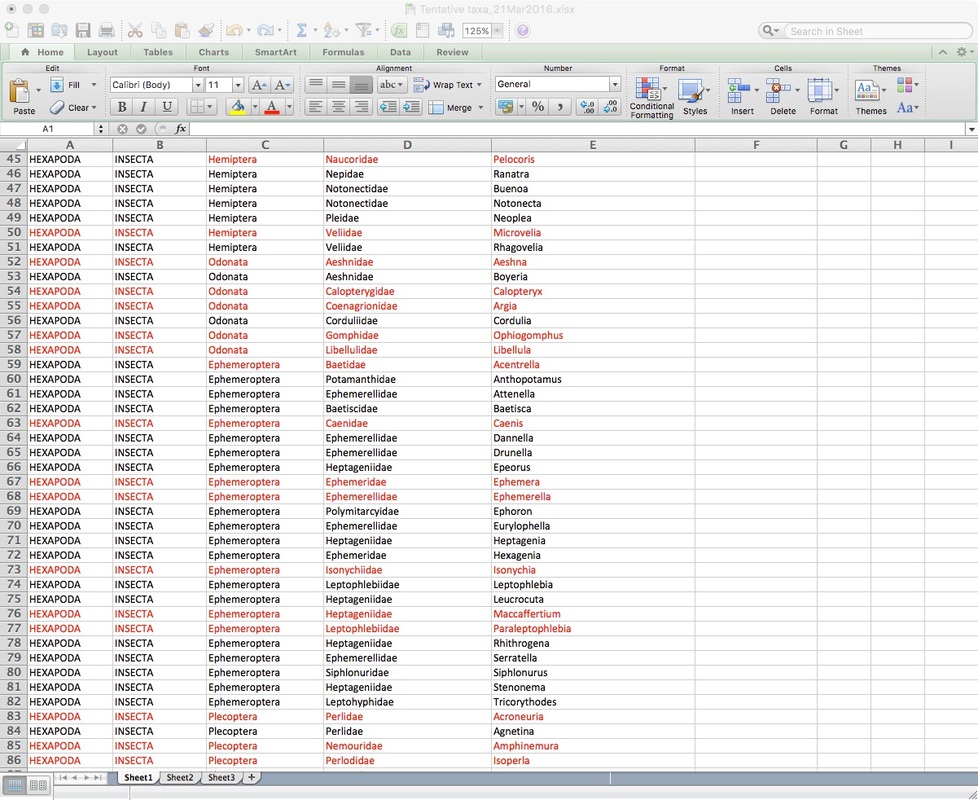 This is a draft list of the most common aquatic macroinvertebrates in the Eastern / North Eastern USA. The insects in red have been identified as candidates for full annotation in the expanded macroinvertebrates.org teaching collection. The realization that there are many, many repeated diagnostic characters across orders and families was important for how we are designing the content management system. In the past system, for only 12 insects, it wasn't so terrible to have to input each diagnostic character for each individual specimen. But when we are dealing with multiple views of 50+ fully annotated specimens, our entomologists will need to be able to enter the order, family, and genus level diagnostic characters and want to know that they will be automatically updated to all the insects within those orders, families, and genera, while bearing in mind that custom overrides are need for special cases.
Design Implications We are excited about the the new kinds of digital possibilities this highly structured, hierarchical organization of information, annotated diagnostic characters in sub-sampled areas of the images and the ensuing affordances for brand new visual ways of filtering, comparing and contrasting views of different diagnostic characters within and across different orders and families of insects. By Molly Johnson, http://www.explorableimages.org/2013/04/survey-of-educational-tools.html Survey of educational tools After talking to experts about the different tools used to learn about and identify macroinvertebrates, we put together a collection of seventeen interesting and representative tools. For each tool we compared the information provided, the expected usability (we did not test all the tools, only provided our opinion), the intended user group. We found a number of interesting interactive and print tools both to learn more about macroinvertebrates and identify the insects in the field or in a lab. Looking at a wide variety of tools helped us understand the level of detail necessary for our tool. It helped us understand how different publishers organize information, and what features may be particularly useful to users. For example, we found that many ID tools forgo the dichotomous key in favor of a pallet of images or illustrations, making it easier for novice users to look for a visual match, rather than trying to answer a number a questions. Download full survey document Selected Examples Flashcards These flashcards provide a great overview. The clear illustrations are particularly effective because they illustrate the distinct characteristics of each insect.We also really like the “Actual Size Range“ indicator. It put the insects into perspective and is more effective than a written size range (e.g. 3mm-12mm). The written content on the back of the cards could be more clear if it was written as simple bullets rather than full sentences. Product Page Guide Book This is a broad book that includes a key as well as guides of how to correctly collect and identify macro-invertebrates. The writing seems dense, but the key and details seem pretty high level, making it difficult to say exactly who the audience of this book is. I expect that it would be used by a professional, non expert, entering the field, wanting an overview of macro-invertebrate collection, identification and stream health monitoring process. Product Page Online Interactive Key This online dichotomous key is very simple, but effective if the user understands the language and knows what they are supposed to be observing. However, for a very novice user, it may be difficult to use. There is no way to change answers from previous pages without moving backwards through the pages, so if you reach the end of the key and have the wrong answer, you have little choice but to start over. Go to Key Stream Insects ID Card This ID card gives a nice broad overview of aquatic insects. The information it gives is very limited, and the images small, but it seems like an effective ID tool. Rather than a key that most ID tools use, this is just a pallet of illustrations on two 8.5x14” sheets of paper. For novice users, this is likely the most effective way to ID orders, just searching for the image that most closely matches. The information is simple, but appropriate for this pallet. More information would have taken up too much space and forced this to be a longer document, making it less effective. Download PDF One of the more challenging and important parts of our project is capturing ultra-high resolution, focus-stacked images ("GigaMacro" or "GigaPan" images) of fairly tiny specimens of the macroinvertebrates in our growing teaching collection. Part of making sure we are generating a high-quality online teaching resource is making sure that our equipment and, perhaps even more importantly, our techniques, are utilizing the best possible practices in all respects. This means experimenting to figure out what works best for the different sorts of insect specimens! For the first experiment, our image specialist and entomologist, Andrea, prepared the insect specimens to be photographed by placing them in small, round containers. The camera takes the photos from the top, so there are were several options we wanted to test: do the images look better (in terms of lighting, etc) if the insects are photographed in an opaque container, or one with clear sides? There was no definitive answer to this question as far as we could find, so Andrea conducted this (and other) experiments to find out. Most of the aquatic insects to be imaged for this teaching collection are preserved in ethanol, but because it evaporates so quickly, and the specimens can move around in it, Andrea uses a mixture of ethanol and alcohol gel (aka hand sanitizer) to capture the images. Here is Andrea's description of the technical aspects of this experiment: Both trials were in gel and ethanol, DOF 0.05, ISO 100, flash at 1/16, shutter speed 1/100, and F aperture 6.3. Here are the results: 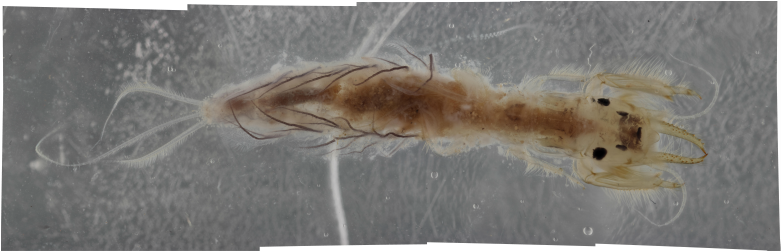 Test 2: Dorsal view of order Ephemeroptera, Family Polymitarcydae, Genus Ephoron in clear container. 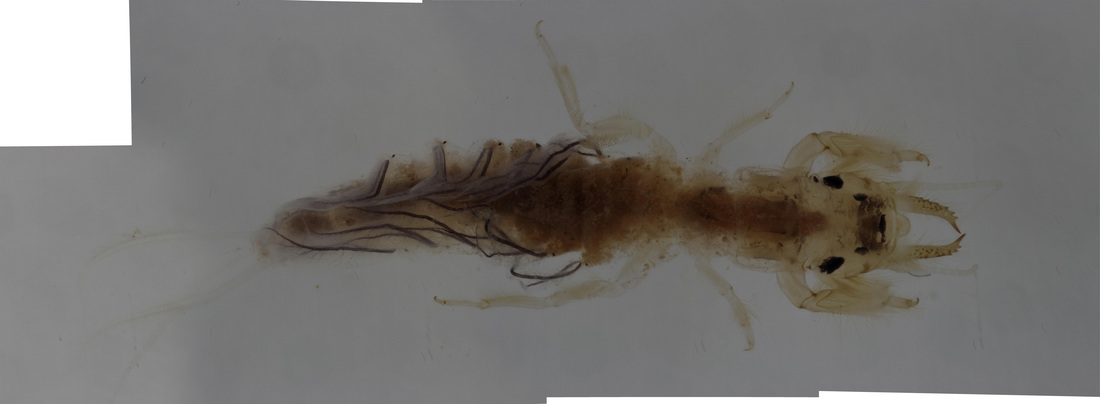 Test 1: Dorsal view of order Ephemeroptera, Family Polymitarcydae, Genus Ephoron in opaque container. |
Project TeamAn interdisciplinary team Categories
All
Archives
June 2023
|

 RSS Feed
