
|
Madeline Genco, entomologist In order to determine which diagnostic characters are most important, I start by going through the Merritt, Cummins, and Berg key, and listing all of the characters for the given taxon. I then delete characters that are used to separate other taxa early on, or characters that are absent and not useful for identification. After I have trimmed this list, the combination of remaining characters gives the correct identification. Often, there is a synapomorphy (uniquely shared character) present, something that is characteristic of just that taxon, and not present in other groups, this character alone can be used for identification; so I try to focus on those. For example, the caddisfly family Lepidostomatidae is the only family where the larvae have the antennae (circled in red below) positioned directly next to the eye. If I see this, I know right away it is Lepidostomatidae, and I don’t have to go through the key. 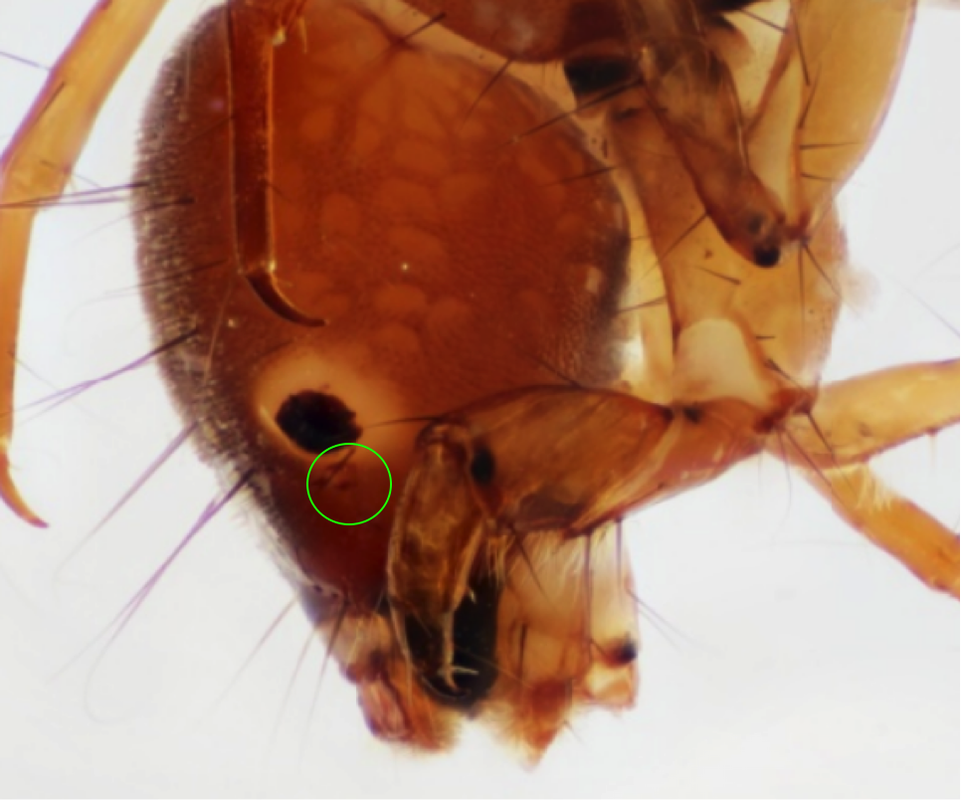 Usually this is a skill that taxonomists and entomologists learn along the way, after identifying and using the key repeatedly. Often, I don’t realize which characters are important until I have had a lot of practice identifying the specimen. You start to just recognize them, like you recognize your friends based on how they look; the same goes for bugs. You just start to recognize them based on features unique to them. We hope that by presenting our users with these important characters first, we can improve the accuracy of their identification and decrease the amount of time needed for training. However, if you are a beginner, it is important to always double check the key. Not only is learning to use the key an important skill for the beginner to learn, but it will confirm the identification.
Comments are closed.
|
Project TeamAn interdisciplinary team Categories
All
Archives
June 2023
|
 RSS Feed
